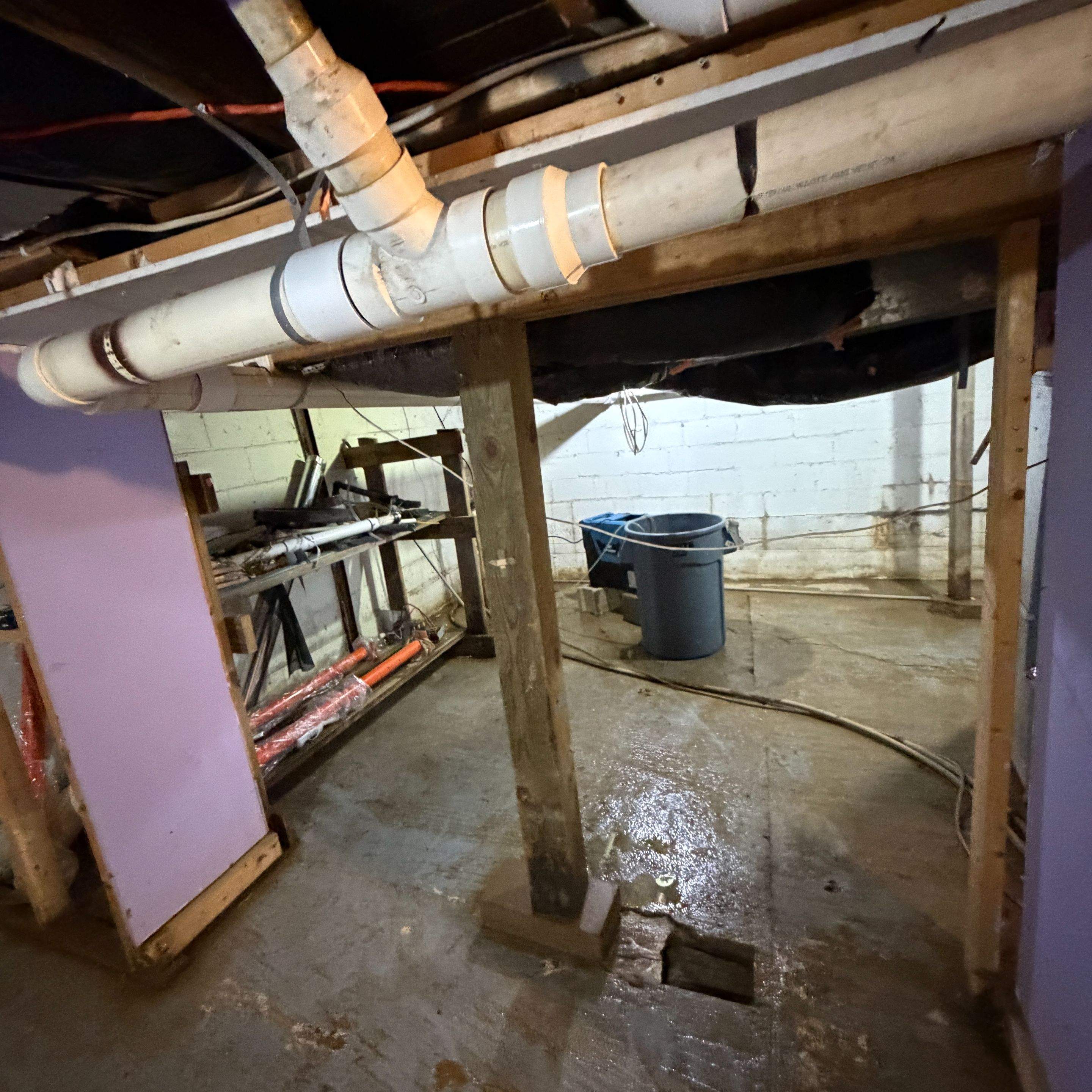
Problem: Standing Water Under Your Home You Cannot Reach
You cannot squeegee a crawl space. Most are 24 to 36 inches tall, packed with ductwork, plumbing, and old debris. By the time you notice water down there, it is often 2 to 6 inches deep across hundreds of square feet, and it has already wicked into the wood above it.
Solution: Low-Profile Extraction and Containment
We bring truck-mounted extractors with low-clearance wands designed to work in tight crawl spaces. For Category 1 clean water from a supply line, extraction usually takes 2 to 6 hours depending on volume. For Category 2 or Category 3 water (groundwater, sewage, long-standing contamination), we set up containment at the access point, suit up in full PPE, and remove water along with any contaminated vapor barrier. If you suspect sewage involvement, our sewage cleanup team follows IICRC S500 protocols for safe removal and disinfection before any drying begins. In tighter access points (less than 18 inches of clearance), we use trash pumps staged outside the crawl with intake hoses fed through the opening, which lets us move 1,500 to 3,000 gallons per hour without sending a technician belly-crawling through contaminated water.
Problem: Saturated Insulation Holding Moisture Against Your Subfloor
Fiberglass batt insulation is the most common type stapled to floor joists in Brendonwood crawl spaces, and it acts like a sponge. Once it gets wet, it sags, loses its R-value, and traps moisture directly against the underside of your floors. Leaving wet insulation in place is the fastest way to turn a water event into a mold event.
Solution: Targeted Removal, Not Blanket Replacement
We assess insulation in sections. Dry batts in unaffected zones stay. Wet, sagging, or contaminated batts come out, bagged on site to prevent spreading spores through your home. Once the insulation is removed, we can read true moisture levels in the subfloor with a penetrating meter. Subfloor moisture above 16 percent means we keep drying. Below 14 percent and we can move to reinsulation planning. We also inspect the kraft paper facing and any wire support rods, because rusted rods often signal that the insulation has been wet on and off for months, not just from this single event.
Problem: The Air in Your Home Already Smells Like the Crawl Space
About 40 to 50 percent of the air you breathe upstairs originates in the crawl space. That is the stack effect at work. If your Brendonwood home smells musty, earthy, or sour, the problem is almost always below your feet.
Solution: Dry the Source, Filter the Air, Then Seal It
We run HEPA air scrubbers inside the crawl space during drying to capture mold spores and particulates before they migrate up. After remediation, encapsulation with a dedicated dehumidifier keeps relative humidity below 55 percent year-round, which is the threshold mold needs to grow. If the original water came from a broken supply line, our breakdown of burst pipe water damage steps and repair costs covers what to expect on the plumbing side. Homeowners often notice the upstairs air clearing within 48 to 72 hours of Brendonwood Water Restoration starting the drying process, which is usually the first sign that the source was correctly identified.
Problem: Wood Rot, Mold, and Structural Concerns Above the Water Line
The water is the visible problem. The damage to floor joists, beams, sill plates, and subflooring is the expensive problem. Mold can begin colonizing wet wood in 24 to 48 hours, and once it gets into structural lumber, you are no longer dealing with cleanup, you are dealing with remediation.
Solution: Drying First, Then Honest Assessment
Here is our order of operations:
- Extract all standing water and remove contaminated materials within the first 24 hours.
- Set commercial dehumidifiers and air movers sized for the cubic footage, typically running 3 to 7 days.
- Monitor daily with moisture meters and hygrometers until wood readings stabilize at 12 to 15 percent.
- Apply antimicrobial treatment to all exposed wood surfaces.
- Identify any joists or beams that need sistering, replacement, or further evaluation by a structural specialist.
If we find rot deep enough that we think you need a structural engineer, we will say so. We do not upsell repairs you do not need. Common red flags we flag for further review include sill plates that crumble under a screwdriver probe, joists with visible delamination, and any beam end resting in a pocket that stayed wet for more than 72 hours.
Problem: A Vapor Barrier That Failed or Was Never There
A torn, displaced, or missing vapor barrier is the reason many Brendonwood crawl spaces stay damp even when there is no active leak. Indiana clay soil holds water, and that moisture migrates straight up into the wood structure of your home.
Solution: Full Plastic Replacement and Sealed Seams
After drying, we install a new 6 to 20 mil reinforced vapor barrier across the entire floor of the crawl space, sealed at the seams and run up the foundation walls. For homes that flood repeatedly, we recommend pairing this with encapsulation and a dedicated dehumidifier. If your water came in through a basement-adjacent crawl space, our basement flooding service page explains how we handle the connection between the two spaces.
Problem: You Do Not Know If Insurance Will Cover This
Crawl space claims get denied more often than basement claims because adjusters argue the damage was gradual. The clock on your claim starts the moment you discover the water.
Solution: Document Before You Touch Anything
- Photograph the water level, the source, and any visible damage before extraction.
- Save the failed component (burst pipe section, broken sump, etc.) for the adjuster.
- Request a written scope from your restoration contractor using IICRC terminology.
- File the claim the same day you discover the loss.
We work directly with insurance adjusters across Brendonwood and document every step using moisture logs, photos, and equipment placement diagrams so your claim has the evidence it needs. If an adjuster pushes back on coverage, Brendonwood Water Restoration can provide drying logs and psychrometric readings that show the loss was sudden, not the result of long-term seepage.